Safety Belt systems are essential restraint components designed to help keep occupants securely positioned during sudden braking, collisions, impacts, and other hazardous movements. Choosing the right belt involves much more than selecting a strap and buckle. Webbing strength, buckle performance, anchorage, locking behavior, material durability, installation, and application requirements all affect the final protection level. This guide explains the key factors buyers, manufacturers, and equipment operators should consider when selecting a reliable safety belt solution.
Article Summary
A properly designed safety belt helps control occupant movement when a vehicle or machine experiences sudden deceleration or abnormal movement. It can reduce the likelihood of an occupant being thrown from a seating position or striking surrounding structures. However, the performance of a restraint system depends on the complete assembly rather than the belt webbing alone.
This article examines safety belt construction, operating principles, important material characteristics, common applications, selection criteria, maintenance considerations, and purchasing requirements. It also explains how Chuanghecheng approaches safety belt manufacturing and customization for different transportation and equipment applications.
What Is a Safety Belt?
A safety belt is a restraint assembly designed to secure a person in a defined seating position. Depending on the application, it may include webbing, buckles, locking devices, adjusters, mounting hardware, retractors, and other supporting components.
In passenger vehicles, the familiar three-point arrangement is widely used because it distributes restraint forces across stronger areas of the occupant's body. Other applications may require two-point, four-point, or five-point configurations. The appropriate configuration depends on vehicle architecture, occupant movement, operating conditions, seating design, and applicable safety requirements.
A high-quality safety belt should not be evaluated only by its appearance. The webbing must maintain adequate strength, the buckle must operate consistently, adjustment hardware must remain secure, and the complete assembly must be compatible with the intended mounting structure.
Why Is a Safety Belt Important?
During normal driving or machine operation, an occupant may experience relatively small changes in movement. The situation changes dramatically during emergency braking, collision events, rollover conditions, sudden acceleration, or abrupt equipment movement.
Without an effective restraint system, the occupant's body can continue moving even after the vehicle or seat has stopped. This can create serious risks, including contact with dashboards, steering systems, doors, machine structures, other occupants, or the ground.
A safety belt helps manage this movement by keeping the occupant connected to the seating system. Its role is therefore not simply to provide comfort or positioning. It is an engineered safety component that forms part of a larger occupant-protection system.
-
Helps maintain a stable seating position during sudden movement.
-
Reduces uncontrolled forward or lateral occupant movement.
-
Helps keep the occupant within the intended protection zone.
-
Can support safer operation of vehicles and specialized equipment.
-
Provides an essential restraint function when integrated correctly with compatible seating and mounting structures.
How Does a Safety Belt Work?
The operating principle of a safety belt is straightforward: it restrains the occupant and limits excessive movement when external forces act on the body. However, achieving reliable performance requires coordinated action among several components.
When a vehicle decelerates rapidly, the occupant tends to continue moving forward because of inertia. The belt provides a controlled connection between the occupant and the seat or vehicle structure. Depending on the design, a locking mechanism or retractor can limit additional webbing movement when rapid belt extension occurs.
The webbing then distributes restraint forces over designated areas of the body. The buckle provides secure engagement and allows controlled release when required. Anchoring components transfer forces into the vehicle or equipment structure.
This is why purchasing decisions should focus on the complete safety belt assembly rather than treating the webbing, buckle, and hardware as independent products.
Key Components of a Safety Belt
A typical safety belt system can contain several important components. Each component must work reliably with the others.
|
Component
|
Primary Function
|
Important Consideration
|
|
Webbing
|
Provides the primary restraint connection
|
Strength, abrasion resistance, flexibility and durability
|
|
Buckle
|
Secures and releases the belt assembly
|
Reliable locking and controlled release
|
|
Retractor
|
Controls webbing extension and storage
|
Smooth operation and dependable locking behavior
|
|
Adjuster
|
Allows belt length adjustment
|
Secure adjustment without unintended loosening
|
|
Anchor Hardware
|
Connects the belt to the structure
|
Compatibility, strength and correct installation
|
Material and Performance Requirements
Material selection has a direct influence on the service life and reliability of a safety belt. Webbing needs to combine strength with flexibility because the belt must withstand repeated handling while remaining comfortable enough for regular use.
Hardware is equally important. Metal components may require suitable strength, surface treatment, corrosion resistance, and dimensional consistency. Plastic components must be selected according to their mechanical and environmental requirements.
For demanding applications, buyers should also consider exposure to ultraviolet radiation, temperature fluctuations, humidity, dust, abrasion, chemicals, and repeated mechanical cycles.
-
High tensile strength: Supports reliable restraint performance.
-
Abrasion resistance: Helps reduce premature webbing damage.
-
Environmental durability: Important for outdoor and industrial applications.
-
Stable hardware: Reduces the risk of inconsistent locking or adjustment.
-
Controlled stitching: Helps maintain the integrity of sewn connections.
-
Dimensional consistency: Supports repeatable assembly and installation.
Common Safety Belt Types
There is no universal safety belt configuration for every vehicle or machine. The design should correspond to the actual operating environment.
Two-Point Safety Belt
A simple restraint arrangement commonly used where the application requires basic waist-level restraint and a compact installation.
Three-Point Safety Belt
A widely recognized configuration that combines lap and shoulder restraint for passenger transportation applications.
Four-Point Safety Belt
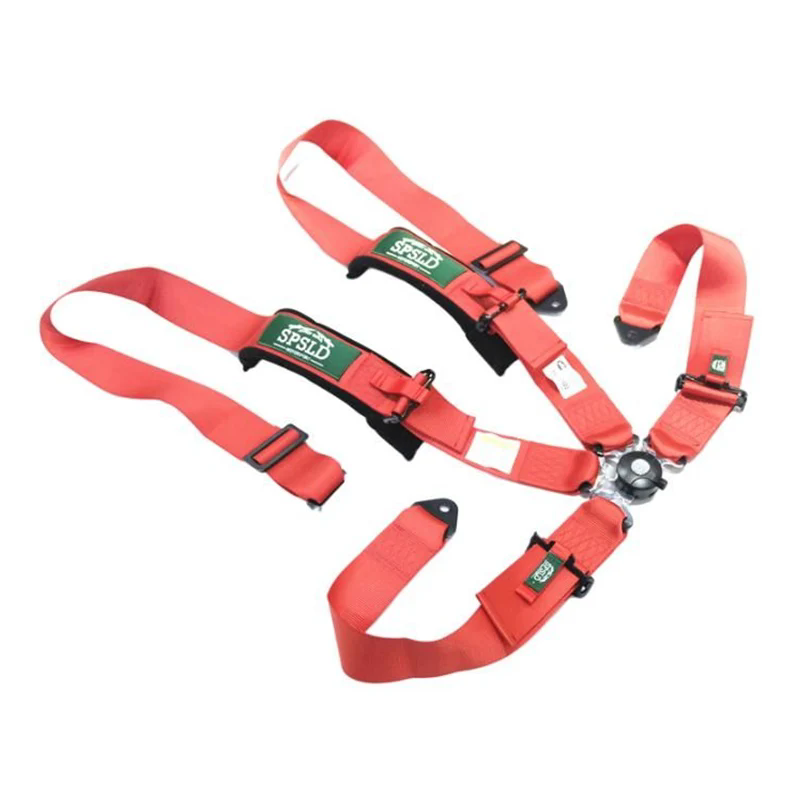
Uses multiple attachment points and can provide additional upper-body positioning for specialized vehicles and equipment.
Five-Point Safety Belt
Designed for applications requiring more comprehensive occupant positioning, including certain racing, recreational and specialized vehicles.
Where Are Safety Belts Used?
Safety belts are used across a broad range of transportation and industrial environments. The correct product should always be selected according to the specific equipment design and applicable requirements.
-
Passenger cars and commercial vehicles
-
Buses and coaches
-
Trucks and specialized transport vehicles
-
Construction and agricultural machinery
-
Forklifts and industrial vehicles
-
Go-karts and recreational vehicles
-
Racing and performance vehicles
-
Wheelchairs and mobility equipment
-
Amusement and specialized passenger equipment
-
Other customized seating and restraint systems
For manufacturers, one of the biggest challenges is adapting a restraint assembly to different seat dimensions, mounting locations, user requirements, and production specifications. A customizable safety belt supplier can help reduce these compatibility problems during product development.
How to Select the Right Safety Belt
Choosing a safety belt should begin with the application rather than the price. A low-cost belt that is incompatible with the vehicle or seating structure may create installation difficulties, inconsistent performance, and higher replacement costs.
|
Selection Factor
|
Questions to Ask
|
|
Application
|
Is it for a passenger vehicle, truck, machine, recreational vehicle or specialized equipment?
|
|
Belt Configuration
|
Does the application require two-, three-, four-, or five-point restraint?
|
|
Webbing
|
Is the webbing suitable for the required strength, abrasion and environmental conditions?
|
|
Buckle
|
Can it provide secure engagement and practical emergency release?
|
|
Installation
|
Are the mounting points, hardware and belt dimensions compatible with the equipment?
|
|
Customization
|
Does the supplier support customized length, color, buckle, hardware or configuration?
|
|
Production Capability
|
Can the supplier maintain consistent quality and stable delivery for recurring orders?
|
For OEM buyers, it is also important to provide the supplier with accurate technical information before production. Seat dimensions, mounting positions, belt length, buckle orientation, required configuration, operating environment, expected order volume, and applicable market requirements should be clearly communicated.
Quality Control and Manufacturing Considerations
Reliable safety belt manufacturing requires process control throughout the production chain. A finished assembly may look simple, but multiple manufacturing steps can influence its final performance.
For example, webbing production and cutting need consistent dimensions. Stitching must be controlled to maintain reliable connections. Metal components require accurate forming and suitable surface treatment. Plastic components require stable molding processes. Final assembly should verify that individual components work together correctly.
Chuanghecheng combines injection molding, metal stamping, mold development, high-strength sewing, and assembly capabilities to support different restraint-system requirements. The company states that its production and quality systems include IATF 16949 and ISO 9001 certification, while its product range covers multiple restraint configurations and specialized applications.
For international buyers, supplier evaluation should include more than certification documents. Ask about manufacturing capacity, traceability, inspection procedures, sample approval, customization capability, quality consistency, packaging, lead time, and after-sales technical support.
Maintenance and Inspection
A safety belt should be inspected regularly, particularly in vehicles and machines exposed to frequent use or harsh operating conditions. Routine inspection can identify visible problems before they become more serious.
Operators and maintenance personnel should pay attention to the following conditions:
-
Frayed, cut, torn, or heavily abraded webbing
-
Discoloration or deterioration caused by environmental exposure
-
Loose or damaged stitching
-
Buckles that do not engage or release normally
-
Damaged adjusters or mounting hardware
-
Unusual retractor behavior
-
Corrosion on metal components
-
Evidence of previous severe impact or abnormal loading
A damaged restraint component should not simply be repaired with an improvised modification. Replacement should follow the equipment manufacturer's instructions and the requirements applicable to the specific application.
Why Consider Chuanghecheng?
For companies purchasing safety belts in volume, the supplier's engineering and manufacturing capabilities can be as important as the product itself. Different vehicles and machines often require different belt lengths, attachment arrangements, buckles, materials, colors, and mounting hardware.
Chuanghecheng has extensive experience in the production of restraint assemblies and provides products for vehicles, buses, trucks, construction machinery, recreational equipment, wheelchairs, and other applications. Its manufacturing capabilities cover several key processes, including metal stamping, injection molding, mold development, sewing, and final assembly.
The company also provides customized and OEM/ODM solutions. This can be useful for manufacturers that need a safety belt adapted to a particular seat design instead of relying on a generic off-the-shelf product.
For OEM and wholesale buyers, a suitable supplier should ideally provide:
-
Application-specific technical support
-
Multiple safety belt configurations
-
Customized dimensions and components
-
Controlled manufacturing processes
-
Stable production capacity
-
Quality documentation and traceability
-
Support for international market requirements
Frequently Asked Questions
What is the main purpose of a safety belt?
The primary purpose is to restrain an occupant and help control body movement during sudden deceleration, collisions, abrupt vehicle movement, or other hazardous events.
What is the difference between a safety belt and a seat belt?
The terms are often used interchangeably, but “safety belt” can describe a broader range of restraint systems used in vehicles, machinery, recreational equipment, and specialized seating. “Seat belt” is commonly associated with vehicle occupant restraint.
Which safety belt configuration should I choose?
The appropriate configuration depends on the vehicle or equipment, seating arrangement, occupant requirements, mounting structure, and applicable regulations or manufacturer specifications. Two-, three-, four-, and five-point systems are designed for different applications.
Can safety belts be customized?
Yes. Depending on the manufacturer, customization can include belt length, webbing color, buckle design, mounting hardware, configuration, stitching details, and other application-specific requirements.
What should I check before buying safety belts in bulk?
Confirm the intended application, configuration, dimensions, mounting points, webbing requirements, buckle type, environmental conditions, applicable market requirements, sample approval process, production capacity, quality control procedures, and delivery schedule.
How long can a safety belt be used?
Service life depends on the design, operating environment, frequency of use, maintenance, exposure to sunlight or chemicals, and whether the belt has experienced abnormal loading. Regular inspection and replacement according to the equipment manufacturer's requirements are essential.
Can Chuanghecheng provide OEM safety belt solutions?
Chuanghecheng provides customized and OEM/ODM safety belt solutions for different vehicle and equipment applications. Buyers can discuss required dimensions, configurations, components, materials, and other specifications with the manufacturer before production.
Conclusion
A safety belt is a relatively compact component, but its role in occupant protection is significant. Reliable performance depends on the interaction of webbing, buckles, retractors, adjusters, stitching, mounting hardware, and the surrounding seating structure.
For vehicle manufacturers, equipment producers, distributors, and industrial buyers, selecting a safety belt should therefore involve a complete assessment of application requirements, material performance, configuration, installation, quality control, supplier capability, and long-term durability.
Whether you need a standard restraint system or a customized solution for a specialized vehicle or machine, working with an experienced manufacturer can simplify product development and improve supply consistency. With its manufacturing capabilities, product range, customization options, and experience in restraint systems, Chuanghecheng can support customers looking for dependable safety belt solutions for different applications.
Looking for a Reliable Safety Belt Supplier?
If you are sourcing safety belts for vehicles, trucks, construction machinery, recreational equipment, or customized applications, Chuanghecheng can help evaluate your requirements and develop a suitable restraint solution.
Contact Chuanghecheng today to discuss your safety belt requirements, OEM/ODM project, product specifications, and bulk order needs. Please contact us for a professional solution tailored to your application.